


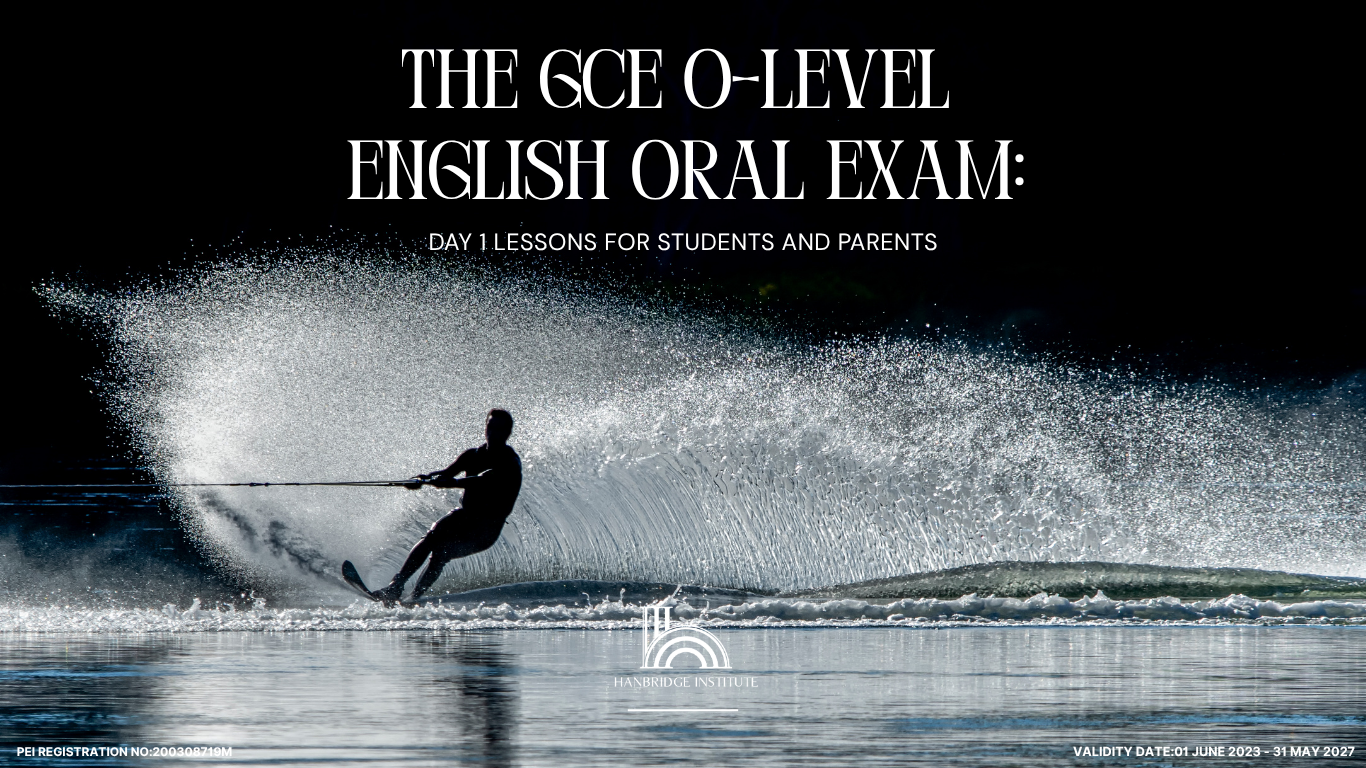
The GCE O-Level English Oral Exam: Day 1 Lessons for Students and Parents
The GCE O-Level English Oral Exam is officially underway, marking an important milestone for students preparing for the Singapore-Cambridge GCE O-Level examinations.
On the first day of the examination, students across Singapore encountered a video stimulus centred on waterskiing, an unfamiliar sport for many candidates. Based on feedback from students at Hanbridge Institute, the topic initially surprised some students. However, it quickly became clear that the examination was not testing their knowledge of the sport itself.
Instead, the GCE O-Level English Oral Exam assessed something much broader—the ability to understand the theme, organise ideas logically, and communicate opinions with confidence.
As the Oral Examination continues this week, the first day’s discussion offers valuable lessons for both students and parents.
Disclaimer: The observations shared in this article are based on students’ recollections after the examination and are intended solely for learning and revision purposes.
They do not represent the official examination questions or materials. Students should always refer to the Singapore Examinations and Assessment Board (SEAB) for official information regarding the GCE O-Level English Oral Exam.
Day 1 of the GCE O-Level English Oral Exam: What Students Recalled
According to feedback from our students, the Day 1 video stimulus focused on waterskiing, falling within the broader theme of Sports and Recreation.

Many students expected more familiar sports such as football, basketball or badminton. Instead, they were introduced to a less common water sport, prompting one of the most frequent questions we heard after the examination:
“What if I don’t know the name of the sport?”
Fortunately, students did not need to identify the exact name of the activity to respond confidently.
By recognising that it was a water sport, an outdoor recreational activity, and a topic connected to health, fitness, and recreation, many students were able to organise their responses effectively.
Based on students’ recollections, the discussion included questions similar to:
- Would a sport like the one shown in the video appeal to most people?
- Do you think this type of sport appeals more to young people? Why?
- Given Singapore’s limited land, should more recreational and sports facilities be built?
Although the video featured an unfamiliar activity, the questions encouraged students to think beyond the sport itself. They needed to explain their opinions, justify their viewpoints, and relate the discussion to everyday life in Singapore.
Consequently, students who focused on the broader theme often found it easier to develop well-organised responses.
What Was the GCE O-Level English Oral Exam Really Testing?
At first glance, Day 1 appeared to focus on waterskiing. In reality, the examination assessed a much wider range of communication skills.
1. Understanding the Theme
Rather than testing students’ knowledge of waterskiing, the examination encouraged them to identify the broader topic.
Once students recognised that the discussion centred on sports, recreation and healthy living, they could organise their ideas more naturally.
This is precisely why we remind students not to panic when they encounter unfamiliar topics.
2. Explaining Opinions Clearly
Likewise, the examination was never about finding the “correct” answer.
Whether students agreed or disagreed, they needed to explain their reasoning, consider different perspectives, and support their opinions with relevant examples.
For example, students could discuss health benefits, safety considerations, accessibility, or personal preferences.
Ultimately, a well-supported opinion carries more weight than a simple “yes” or “no”.
3. Connecting Ideas to Everyday Life
Furthermore, the discussion extended beyond sport itself.
Students were encouraged to connect the topic to wider issues such as healthy lifestyles, public facilities, Singapore’s limited land, and community well-being.
These connections demonstrated critical thinking and showed that students could relate the discussion to real-life situations.
Three Reminders as the GCE O-Level English Oral Exam Continues
With the GCE O-Level English Oral Exam continuing throughout the week, here are three important reminders from our English teacher, Ms Manjit.
1. Stay Calm and Trust Your Preparation
Even the best-prepared students can become nervous when they encounter an unfamiliar topic.
However, remaining calm allows you to think clearly and organise your ideas before speaking.
Remember, the examination is assessing how you communicate—not whether you know every answer.
2. Listen Carefully Before You Respond
Next, take time to listen to the entire question before answering.
Many students hear one familiar keyword and immediately begin speaking. Unfortunately, this often leads them away from the actual question.
Instead, identify the key message first, organise your thoughts, and then respond with confidence.
3. Understand the Topic—Don’t Memorise Answers
Finally, avoid memorising model responses.
The first day of the GCE O-Level English Oral Exam reminded us that topics can take unexpected directions.
Students who relied on memorised answers often struggled to adapt. In contrast, those who understood broader themes and knew how to develop their ideas communicated more naturally.
Therefore, continue building your knowledge through current affairs, classroom discussions, and regular practice rather than memorising scripts.
How Hanbridge Institute Prepares Students for the GCE O-Level English Oral Exam
At Hanbridge Institute, Oral preparation extends beyond practising examination questions.
Throughout the programme, students participate in:
- Internal mock oral examinations
- Discussions on current affairs
- Presentation and conversational activities
- Opinion-building exercises
- Responsible research using Artificial Intelligence (AI)
More importantly, students learn how to organise ideas, analyse unfamiliar situations, and communicate confidently.
As a result, they become better prepared not only for the GCE O-Level English Oral Exam, but also for interviews, presentations, higher education, and future careers.
Final Thoughts
Overall, the first day of the GCE O-Level English Oral Exam serves as an important reminder that unfamiliar topics should never become a source of panic.
Instead, students should focus on understanding the broader theme, organising their ideas logically, and communicating their opinions with confidence.
As the Oral Examination continues this week, remember to:
✔ Stay calm.
✔ Listen carefully.
✔ Think before you answer.
✔ Trust your preparation.
Most importantly, remember that the examiner is not looking for perfect answers.
Rather, they are looking for students who can communicate thoughtfully, confidently, and authentically.
From everyone at Hanbridge Institute, we wish all students every success in the remaining days of the GCE O-Level English Oral Exam.