



Singapore Education System: What Oxbridge Admissions Reveal
Why Are Singapore Students Performing So Well at Top Global Universities?
Oxford and Cambridge are among the world’s most competitive universities. Every year, thousands of academically accomplished students compete for a limited number of undergraduate places.
Yet within this highly competitive international applicant pool, students applying from Singapore continue to stand out.
Oxford’s latest Annual Admissions Statistical Report 2026 covers five admissions years from 2021 to 2025. In 2025 alone, Oxford admitted 3,302 undergraduate students.
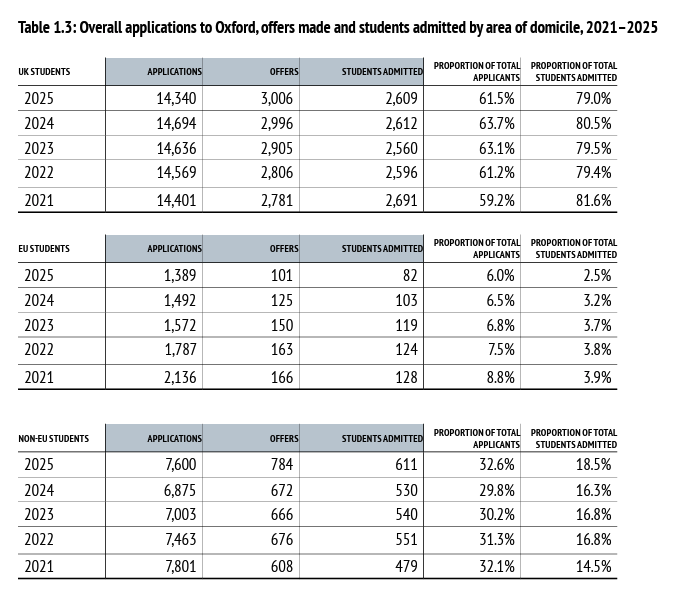
Image Source: Oxford Annual Admissions Statistical report 2026
But the more interesting question for international families is not simply how many Singapore students enter Oxford or Cambridge.
It is:
What is it about the Singapore education system that helps academically strong students prepare for highly competitive universities around the world?
For international students considering whether to study in Singapore, the answer provides an interesting perspective on what an education journey here can potentially offer.
Singapore’s Oxbridge Performance Is Worth Looking At
Singapore is a relatively small country, yet students from its schools have established a notable presence at Oxford and Cambridge.
A 2024 report by The Straits Times found that Raffles Institution (RI) and Hwa Chong Institution (HCI) were the only two schools outside Britain featured in a league table of schools receiving the highest numbers of Oxford and Cambridge offers.
According to the figures cited:
Raffles Institution
37 Oxford offers | 49 Cambridge offers
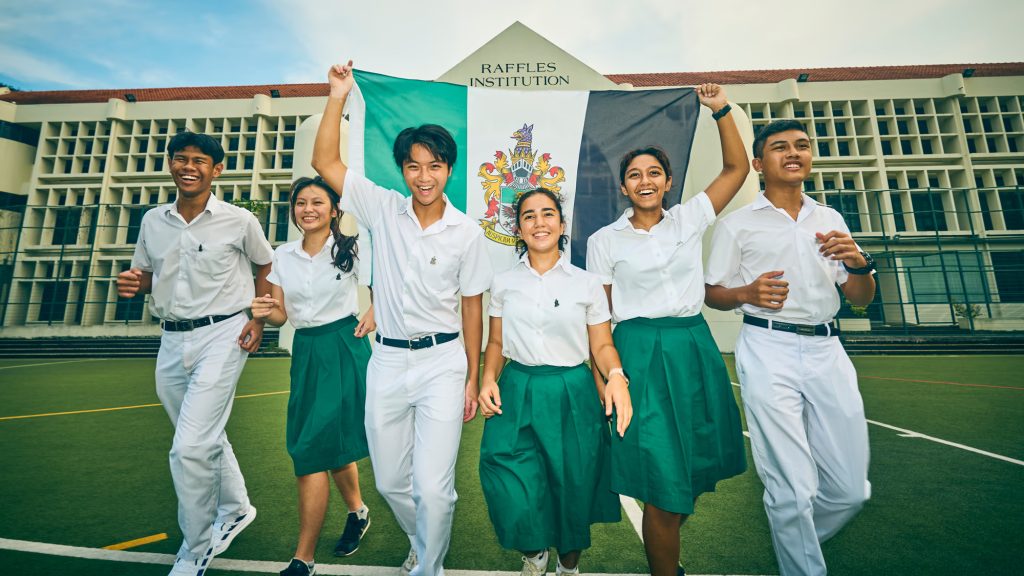
Image Source: Raffle Institution Website
Hwa Chong Institution
29 Oxford offers | 34 Cambridge offers
Both institutions typically sent around 90 to 100 applications to Oxford and Cambridge each year.
These figures should not be interpreted as suggesting that studying in Singapore makes admission to Oxford or Cambridge easy.
It doesn’t.
Instead, they raise a more useful question about the academic environment, preparation and pathways surrounding high-performing students in Singapore.
1. A Rigorous Academic Foundation
Singapore’s education system places considerable emphasis on building strong academic foundations.
For students progressing through secondary education and into Junior College, academic preparation becomes increasingly specialised and demanding.
But Singapore’s education system is also changing.
Full Subject-Based Banding (Full SBB) has been fully implemented in secondary schools since 2024, providing students with greater flexibility to take subjects according to their strengths and interests.
From 2027, the new Singapore-Cambridge Secondary Education Certificate (SEC) examination will also replace the existing N- and O-Level examinations, with students sitting subjects at G1, G2 or G3 levels.
For international families, understanding these changes is increasingly important when planning a child’s longer-term Singapore education pathway.
2. Education Goes Beyond Examination Results
Strong grades remain important, particularly for highly competitive universities.
But academic achievement alone does not explain the entire picture.
Singapore’s education system also provides opportunities for students to develop through academic activities, competitions, co-curricular activities and other experiences beyond classroom examinations.
For students considering competitive universities overseas, exposure to these experiences can help them develop qualities such as:
- Critical thinking
- Communication
- Academic curiosity
- Independence
- Problem-solving
- Confidence in expressing ideas
These capabilities become increasingly important as students progress towards higher levels of education.
3. University Guidance Can Make a Difference
Another factor is access to information.
The Straits Times reported that schools such as RI and HCI have established systems supporting students applying to overseas universities, including guidance around applications, interviews and important deadlines. Their alumni networks can provide another source of information and experience.
This matters because applying to a highly selective international university involves much more than submitting good examination results.
Students need to understand course requirements, admissions assessments, interviews, application timelines and what universities expect from prospective applicants.
A strong educational environment therefore doesn’t simply teach students what to learn.
It can also help them understand where that learning can take them.
4. Your Environment Can Shape Your Ambitions
There is another factor that is harder to quantify: the people around you.
When students regularly encounter seniors, classmates and alumni pursuing ambitious academic goals, those possibilities can begin to feel more achievable.
Oxford itself states that its admissions approach focuses on identifying academic potential, with admissions processes intended to be rigorous and based on academic merit and potential.
This is why the value of an education environment cannot be measured solely through examination results.
A strong environment can encourage students to ask bigger questions about what they want to study, where they want to go and what they may be capable of achieving.
What Does This Mean for International Students?
For international families, the lesson should not be:
“Study in Singapore, and your child will have a better chance of entering Oxford or Cambridge.”
University admission can never be guaranteed, and students competing for places at highly selective universities represent an exceptional applicant pool.
The bigger takeaway is that the Singapore education system provides multiple pathways through which students can progressively develop academically and personally.
An international student entering a Singapore government school may progress through secondary education before considering pathways such as Junior College, Polytechnic or other post-secondary options.
And these pathways are continuing to evolve. From 2028, students receiving the new SEC qualification will be able to apply to Junior Colleges, Millennia Institute, Polytechnics and ITE through Singapore’s new Post-Secondary Admissions Exercise.
The destination does not have to be Oxford or Cambridge.
For some students, the goal may be NUS, NTU or another university. Others may prefer a Polytechnic pathway that emphasises applied learning before progressing further.
That diversity of possibilities is an important part of studying in Singapore.
Where Does AEIS Fit Into the Singapore Education Pathway?
For international students seeking admission to Singapore government primary and secondary schools, the Admissions Exercise for International Students (AEIS) can represent an important entry point into the local education system.
But passing AEIS should not be viewed as the final destination.
It can be the beginning of a much longer education journey.
Students entering Singapore schools need to adapt to an English-medium learning environment, new academic expectations and the wider experience of studying within Singapore’s education system.
This is why effective AEIS preparation should go beyond preparing students to answer examination questions.
Building strong foundations in English and Mathematics, developing effective learning habits and becoming comfortable with Singapore’s academic environment can support students as they move into the next stage of their education.
More Than an Examination, It Is a Pathway
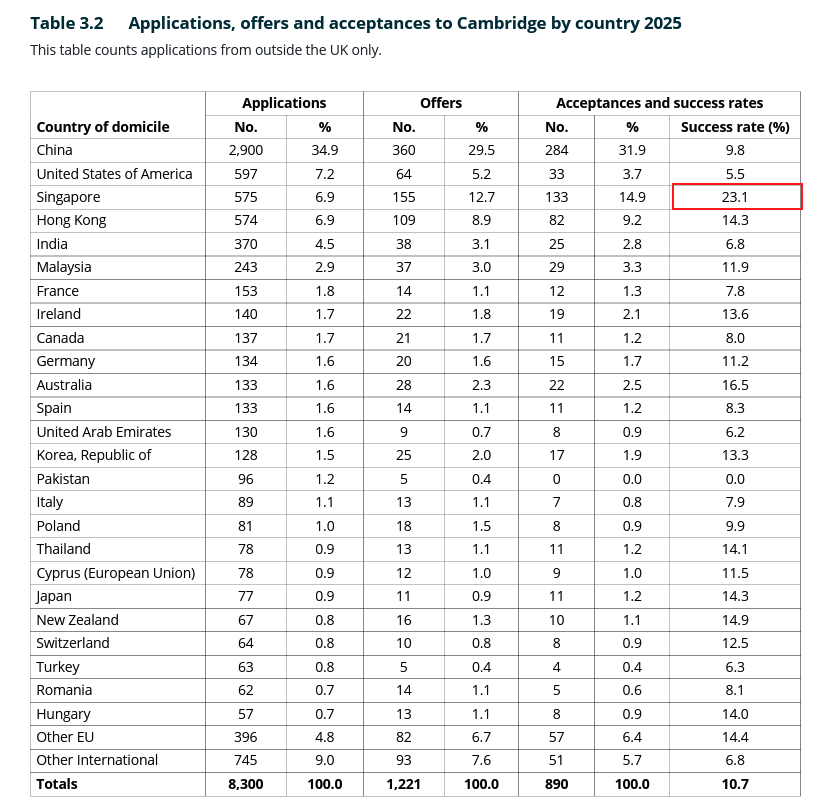
Image source: Cambridge official annual admissions data
The latest Oxford and Cambridge admissions data should not be interpreted as proof that Singapore provides a shortcut to the world’s most prestigious universities.
There is no shortcut.
What the figures do demonstrate is that high-performing students educated in Singapore can compete successfully within some of the world’s most demanding university admissions environments.
For international parents considering whether their child should study in Singapore, that may be the more meaningful takeaway.
The value of the Singapore education system lies not in guaranteeing one particular destination, but in giving students opportunities to build strong foundations, discover their strengths and progress through different academic pathways over time.
For some international students, that journey may begin with AEIS.
And where it eventually leads can extend far beyond the first school they enter.
Explore AEIS Preparation at Hanbridge Institute
Hanbridge Institute’s AEIS Preparatory Course in Singapore supports international students preparing for the English and Mathematics requirements of the AEIS examination.
Through structured preparation and familiarity with Singapore’s academic expectations, students can work towards the first step in their journey into the Singapore education system.
Contact our education consultants to learn more about AEIS preparation and studying in Singapore.
🌐 https://hanbridge.edu.sg/contact-hanbridge-institute/
💬 https://wa.me/6580665486
Sources & References
Hanbridge Institute (2026) Preparatory Course for Admissions Exercise for International Students (AEIS).
https://hanbridge.edu.sg/program/aeis/ (Accessed: 13 August 2026).
Ministry of Education, Singapore (2024) Full Subject-Based Banding (Full SBB).
https://www.moe.gov.sg/psle-fsbb/full-subject-based-banding/main (Accessed: 13 August 2026).
Ministry of Education, Singapore (2024) Singapore-Cambridge Secondary Education Certificate (SEC) examinations.
https://cos.moe.gov.sg/2024-announcements/ (Accessed: 13 August 2026).
Ministry of Education, Singapore (2026) Admissions Exercise for International Students (AEIS).
https://www.moe.gov.sg/international-students/aeis (Accessed: 13 August 2026).
The Straits Times (2024) ‘More S’porean students heading to Oxbridge: What’s fuelling them?’, The Straits Times, 4 February.
https://www.straitstimes.com/singapore/more-s-porean-students-heading-to-oxbridge-what-s-fuelling-them (Accessed: 13 August 2026).
University of Cambridge (2026) Undergraduate Admissions Statistics: 2025 Cycle. Cambridge: University of Cambridge.
https://www.undergraduate.study.cam.ac.uk/sites/default/files/2026-05/ug_admissions_statistics_2025_cycle.pdf (Accessed: 13 August 2026).
University of Oxford (2026) Annual Admissions Statistical Report 2026. Oxford: University of Oxford.
https://assets-oxweb.admin.ox.ac.uk/2026-07/Undergraduate%20Admissions%20Report%202026_0.pdf (Accessed: 13 August 2026).