


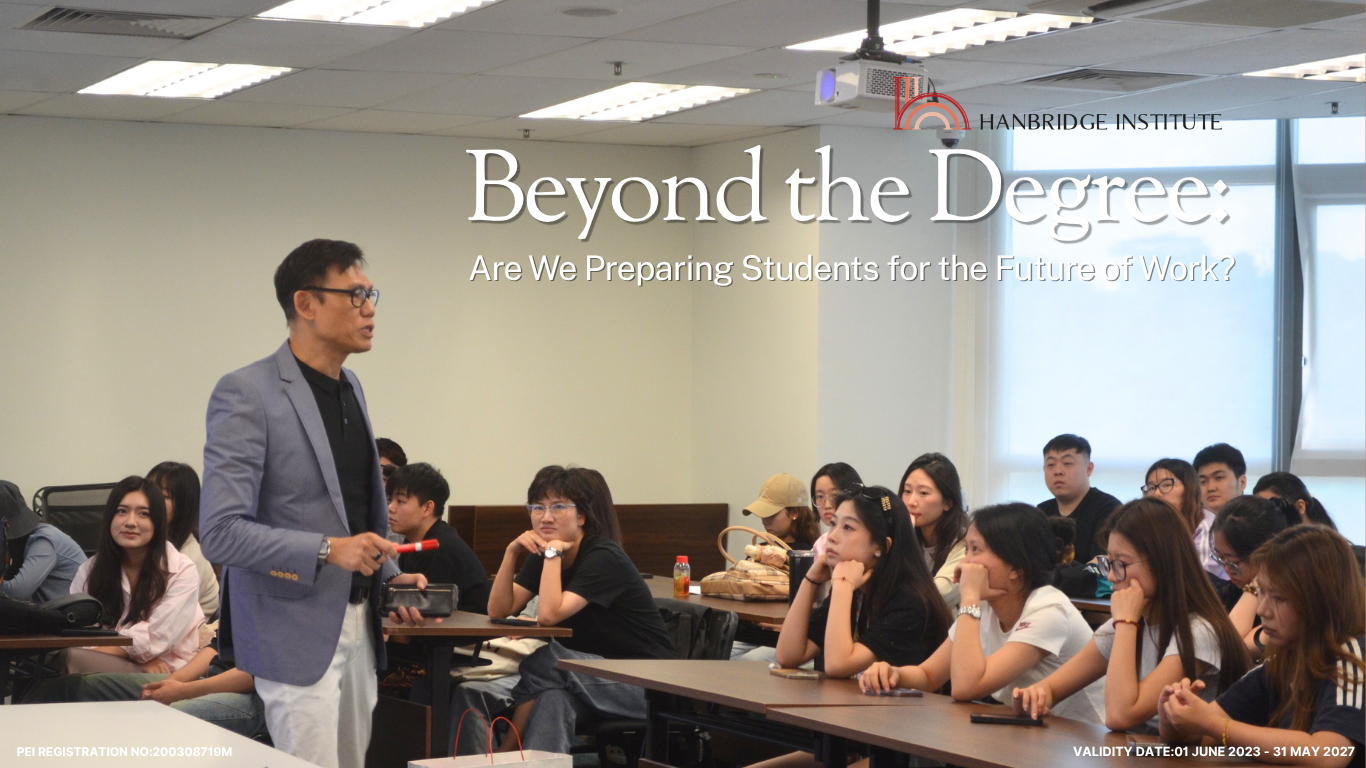
Beyond the Degree: Are We Preparing Students for the Future of Work?
For generations, earning a university degree has been viewed as an important milestone.
It represents years of learning, dedication, and the development of knowledge within a chosen field.
However, as industries evolve and workforce expectations continue to change, a bigger conversation is emerging:
Is having a qualification alone enough, or how we can better prepare individuals to apply what they have learned?
When Graduates Return to Learn Again
A recent South China Morning Post article highlighted an interesting trend in China, where some university graduates have enrolled in technical schools after completing their degrees.
For many, the decision was not about replacing their academic education. Instead, it reflected a desire to strengthen practical skills and improve their readiness for employment in a competitive job market.
The discussion reflects a challenge faced by education systems around the world:
How can education better connect knowledge gained in the classroom with the skills needed beyond graduation?
The Changing Expectations of the Workplace
The relationship between education and employment continues to evolve.
While academic knowledge remains important, employers today increasingly value individuals who can apply what they know in real situations.
Beyond qualifications, graduates are expected to develop:
- Critical thinking
- Problem-solving skills
- Adaptability
- Communication skills
- Continuous learning mindset
The ability to learn does not end at graduation.
In a rapidly changing workplace shaped by technology, AI, and evolving industries, individuals need to continue developing their skills throughout their careers.
Education Is More Than Preparing for Examinations
This conversation extends beyond students entering the workforce.
It also challenges educators to rethink the way learning experiences are designed.
If industries are changing, education must continue evolving as well.
The role of educators today is no longer only about delivering knowledge. It involves helping learners:
- Develop confidence in their ideas
- Think critically about information
- Apply knowledge in different situations
- Build skills beyond academic achievement
Preparing future-ready graduates starts with creating meaningful learning experiences.
Supporting Students Beyond the Classroom
At Hanbridge Institute, this belief aligns closely with our mission:
To nurture students who are able to realise their full potential and achieve their individual aspirations for education and career choices.
With students from different backgrounds, including many from China and across Asia, we recognise that every learner has different goals and pathways.
Beyond academic learning, education should help students develop the adaptability, confidence, and lifelong learning mindset needed for an evolving world.
Preparing Educators for the Future of Learning
As the expectations of students and industries continue to change, educators also play an important role in shaping the future of learning.
The Master of Arts in Education (MA Education) programme, awarded by the University of Suffolk (UK) and delivered at Hanbridge Institute, supports educators and professionals in exploring how people learn, how educational practices can improve, and how learning can better respond to changing needs.
Through areas such as reflective practice, educational research, and leadership, the programme encourages educators to evaluate challenges, enhance learning experiences, and create meaningful impact.
Because preparing students for the future begins with continuously improving how we educate today.
Final Thoughts: Education Does Not End at Graduation
A degree remains an important achievement.
However, in today’s changing world, education is no longer only about reaching the next milestone.
It is about building the ability to continue learning, adapting, and applying knowledge throughout life.
The question is shifting from:
“What qualification do you have?”
to
“How can you continue growing with what you have learned?”
Sources & References
South China Morning Post. (2026). China’s technical schools offer both hope and despair for jobless university graduates. Accessed 9 July 2026.
https://www.scmp.com/news/china/science/article/3359560/chinas-technical-schools-offer-both-hope-and-despair-jobless-university-graduates
Hanbridge Institute. (2026). Master of Arts in Education (MA Education). Accessed 9 July 2026.
https://hanbridge.edu.sg/program/master-of-arts-in-education-ma-education/
Hanbridge Institute. (2026). About Hanbridge Institute. Accessed 9 July 2026.
https://hanbridge.edu.sg/about-hanbridge-institute/