


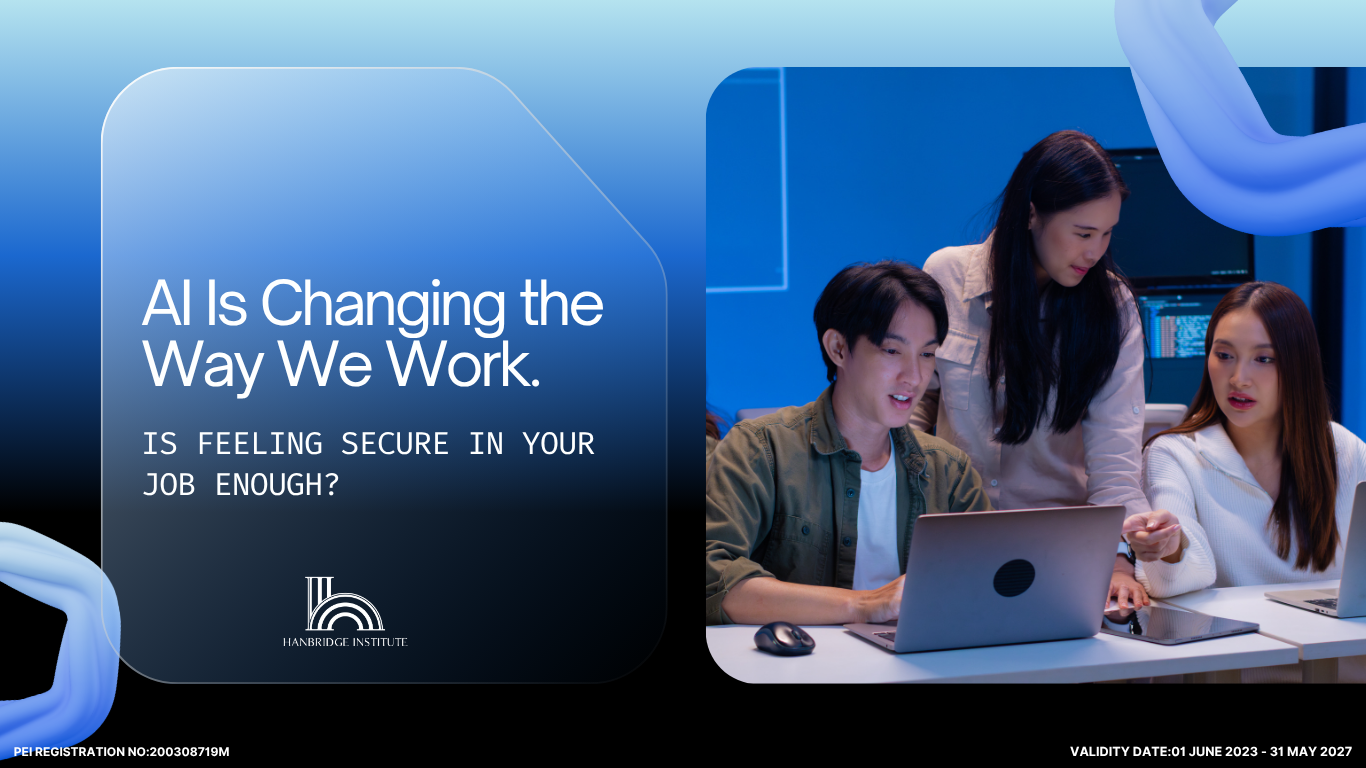
AI Is Changing the Way We Work. Is Feeling Secure in Your Job Enough?
Artificial Intelligence (AI) is no longer a conversation about the future. It is already influencing how industries operate, how businesses make decisions, and how professionals approach their daily work.
In our previous discussions on AI and education, we explored two important questions:
Are students ready for an AI-driven future?
And more importantly:
Are we teaching students what to think, or how to think?
Today, this conversation extends beyond the classroom and into the workplace.
As AI continues to reshape industries, another question emerges:
If my job feels secure today, am I prepared for how it may change tomorrow?
AI Is Not Only Changing Jobs. It Is Changing Tasks.
When discussing AI in the workplace, the focus is often on whether certain jobs will disappear.
However, the reality is more complex.
A recent Straits Times article highlighted that the impact of AI on occupations remains difficult to predict. While some industries may experience greater disruption, the bigger shift may happen at the task level.
The same job title may continue to exist, but how the work is completed could look very different.
Tasks that previously required hours of manual effort may now be completed more efficiently with the support of AI tools. This changes the skills employees need to remain effective in their roles.
AI-enabled professionals who understand how to incorporate technology into their workflow may become significantly more productive compared to those who continue using traditional methods.
The Goal Is Not to Become an AI Prompt Expert
As more AI tools become available, it can be tempting to focus only on learning prompts or collecting the latest AI techniques.
However, the long-term value of a professional is not determined by how many prompts they know.
It comes from understanding:
- What questions to ask
• How to evaluate information
• When human judgement is required
• How to apply industry knowledge effectively
Arthoven Ng, Managing Director of AI training and consultancy firm Overpowered, highlighted the importance of employees honestly reviewing their own work.
This includes identifying repetitive tasks, tasks that require judgement, and tasks that depend on relationships, context, or domain expertise.
AI can assist with generating outputs, but professionals are still responsible for assessing the quality, accuracy, and relevance of those outputs.
Being Comfortable Should Not Mean Standing Still
Feeling secure in your current role is not necessarily a bad thing.
However, in a rapidly changing environment, staying prepared is important.
David Leong, Chairman of PeopleWorldwide Consulting, shared that industry decline does not always mean immediate job loss. However, it can indicate shrinking opportunities, slower wage growth, reduced investment, and fewer pathways for career advancement over time.
Therefore, career security in the future may depend less on the role someone holds today and more on their ability to continuously learn, adapt, and develop new capabilities.
Why Future Readiness Starts Before Entering the Workforce
Adapting to AI should not begin only after starting a career.
It starts with education.
As industries evolve, higher education must prepare students for a world where technology becomes part of everyday decision-making.
Technical knowledge remains important. However, students also need to develop the ability to:
- Think critically
• Interpret information
• Solve complex problems
• Communicate ideas effectively
• Make informed decisions using technology
AI can provide answers, but students must develop the ability to question, refine, and apply those answers.
This is where the role of education continues to evolve.
Preparing Students for an AI-Enhanced Future
At Hanbridge Institute, we recognise that tomorrow’s workforce requires both technological awareness and strong human capabilities.
Through programmes such as the BA (Hons) Business Management, MBA, MSc International Business and Management, and MSc Data Science and Artificial Intelligence, awarded by the University of Suffolk (UK), students develop knowledge and skills that support them in an evolving global workplace.
Beyond understanding new technologies, students are encouraged to develop adaptability, critical thinking, communication skills, and confidence in their own judgement.
As shared by Dr Alan Go, Chairman of the Academic Board at Hanbridge Institute, the focus is not simply on whether students know how to use AI tools, but whether they can use them with purpose and judgement.
“The goal is to ensure that students do not allow AI to shape their thinking, but instead develop the confidence and critical thinking skills to guide AI in transforming their own ideas into meaningful outcomes.” Dr Go said.
Final Thoughts: Learning to Grow With AI
AI will continue changing how industries operate.
The question is no longer:
“Will AI affect my work?”
It already is.
The more important question is:
“How prepared am I to adapt?”
In the future workplace, success may not belong only to those who know the most, but to those who continue learning, questioning, and evolving.
Because in an AI-driven world, the ability to think critically may become one of the most valuable skills of all.
Sources & References
The Straits Times. (2026). askST Jobs: My job feels secure but my industry is in decline due to AI. Should I be worried? Accessed 6 July 2026.
https://www.straitstimes.com/singapore/jobs/askst-jobs-my-job-feels-secure-but-my-industry-is-in-decline-due-to-ai-should-i-be-worried
Hanbridge Institute. (2026). AI Is Changing Every Industry. Are Students Ready? Accessed 6 July 2026.
https://hanbridge.edu.sg/ai-is-changing-every-industry-are-students-ready/
Hanbridge Institute. (2026). The AI Dilemma: Are We Teaching Students What to Think or How to Think? Accessed 6 July 2026.
https://hanbridge.edu.sg/ai-in-higher-education-singapore/
Hanbridge Institute. (2026). Programmes. Accessed 6 July 2026.
https://hanbridge.edu.sg/programmes/